The paid social testing loop that actually survives contact with budget
A practical framework for creative testing when the goal is profitable learning, not a pile of disconnected ads.

Paid social testing gets messy when every ad is treated like a new idea. If you are looking for a partner to run this loop at scale, here is exactly what a real social media marketing agency does differently.
The account fills with one-off hooks, one-off formats, one-off audiences, and one-off explanations for why nothing quite worked. After a month, the team has activity, but no compounding learning.
A testing loop fixes that. It turns creative into a sequence of decisions.
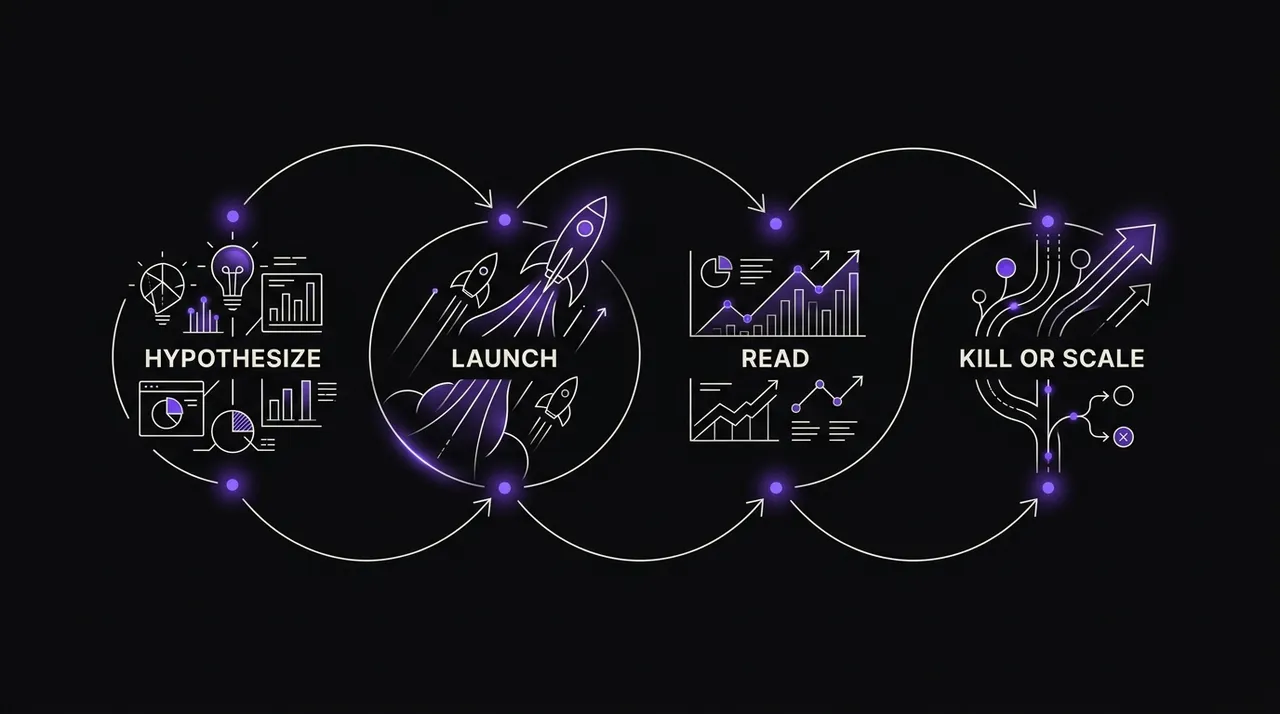
The loop
The basic loop is simple:
| Step | Question | Decision |
|---|---|---|
| Hypothesis | What do we think will make a buyer care? | Pick one angle to test. |
| Variant | How do we express it? | Produce 3 to 5 versions. |
| Spend | How much signal do we need? | Set a small test budget. |
| Read | What happened by audience and stage? | Keep, cut, or revise. |
| Reinvest | What deserved more budget? | Scale only the proven pattern. |
The discipline is not in launching tests. It is in refusing to keep tests alive because somebody likes the creative.
The goal is not to find one winning ad. The goal is to build a machine that finds and retires ideas quickly.
What we learned from TikTok
In Issue #2 of the teardown series, the brand started with no TikTok account and no paid social system. The result came from a testing rhythm, not from a perfect launch.
The account spent about $14K across the new paid social system and produced $104K+ in revenue over eight months. The channel also grew from zero to 6,000 followers, but the follower number was not the point. The real asset was a repeatable way to learn.
That matters because TikTok punishes slow feedback. A monthly creative review is too late. By then, the budget has already learned the wrong lesson.
The two numbers to separate
Every creative test needs two reads.
| Read | What it tells you | Common mistake |
|---|---|---|
| Attention | Did the hook stop the right person? | Scaling high view rate with weak purchase intent. |
| Commercial signal | Did the viewer move toward revenue? | Cutting a useful angle because the first version was rough. |
Attention without commercial signal creates vanity wins. Commercial signal without enough attention creates a production problem, not necessarily a strategy problem.
The best operators separate those reads before changing budget.
A clean weekly rhythm
A practical weekly rhythm looks like this:
- Pick one buyer belief to test.
- Produce multiple hooks for that belief.
- Keep the audience setup boring enough that creative signal is readable.
- Review after the test has enough spend to say something useful.
- Cut losers quickly.
- Turn winners into a new batch of variants.
This is also why a good report matters. If the weekly review only shows impressions, clicks, and engagement, the team cannot tell whether the loop is learning anything valuable. The reporting standard in this scorecard applies directly to creative testing.
The danger zone
The danger zone is the middle: ads that are not obvious losers, but not strong enough to scale.
That is where budgets leak. Teams keep them alive because they might improve, because the creative was expensive, or because nobody wants to call the test. A real loop needs a kill rule before the spend starts.
Your kill rule can be simple:
| If the ad has | And it also has | Then |
|---|---|---|
| Weak hook signal | Weak conversion signal | Cut it. |
| Strong hook signal | Weak conversion signal | Rewrite the offer or landing step. |
| Weak hook signal | Strong conversion signal | Repackage the angle. |
| Strong hook signal | Strong conversion signal | Build variants and scale carefully. |
That table is the work. It turns creative review from taste into operating discipline.
Want us to inspect your paid social testing loop? Book a free audit call. We will show you where the account is learning, where it is guessing, and what to cut first. If you would rather have a partner run the loop on Meta every week, see what our Meta Ads agency service covers.